
Exteriors
The outside of your house has one job before it has any others: keep water out. Everything expensive that goes wrong inside a house — rot, mold, failed framing, ruined insulation — starts with water getting somewhere it shouldn’t.
We handle siding, roofing, windows, doors, trim and decks. Not as separate crews chasing separate jobs, but as one envelope that has to work together.
Siding and the layers behind it
Siding is the visible layer. House wrap, flashing and the details around every window, door and penetration are what actually keep the wall dry. Most siding failures aren’t the siding — they’re a flashing detail someone rushed.
When we open a wall we’ll show you what’s behind it. If there’s rot or failed sheathing, you’ll see photos and get a number before we cover it back up. What we won’t do is side over a problem because the finished result would look the same either way.

Roofing
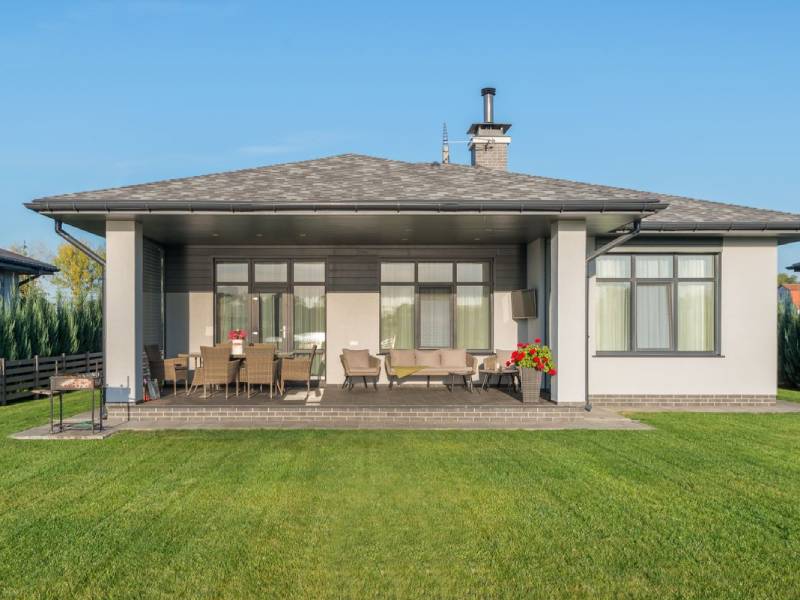
Most roof work here is asphalt shingle, and the difference between a good roof and a cheap one is mostly in the parts you can’t see from the ground: ice and water shield at the eaves and valleys, proper step flashing where the roof meets a wall, sealed penetrations, adequate ventilation.
We’ll tell you honestly whether you need a full replacement or whether a repair buys you another five years. Not every roof we look at needs replacing, and we’ll say so.
Windows and doors
Window replacement is where lead times catch people out. Anything beyond a standard stock size — a particular grille pattern, a clad-wood unit, a non-standard opening — is built to order and can run four to eight weeks. We’ll tell you that up front so it’s planned for rather than discovered.
We also install them properly integrated with the house wrap and flashing, which is the difference between a window that’s weather-tight and one that leaks quietly into the wall for six years.

Decks and outdoor space
Footings below frost line, proper ledger attachment with flashing, correct fastener and joist hardware. Deck failures are almost always the ledger — where the deck meets the house — and they’re almost always preventable.
Composite or wood, we’ll walk you through the real trade-offs: upfront cost against maintenance, how each looks in year ten, what actually matters for how you’ll use it.
Working around weather and inspections
Exterior work is weather-dependent and inspection-dependent, and both affect the schedule in ways nobody controls. What we can control is sequencing — not opening up more of the house than we can close before rain, and booking inspections early rather than when we’re ready for them.
If we lose days to weather, you’ll hear it from us before you notice it yourself.
How an Exterior Project Runs
[Exterior process steps not in the copy doc — placeholder steps below, confirm with Steve.]
Inspection
[We walk the outside of the house, check what’s failing and what isn’t, and tell you honestly what needs doing.]
Scope and estimate
[A written estimate with materials, schedule, and a unit rate for any rot or sheathing we find.]
Ordering and permits
[We order materials, including any built-to-order windows, and handle permits where the job needs them.]
Tear-off and inspection of what's behind
[We open up only what we can close the same day, photograph anything we find, and price it before we fix it.]
Install and weatherproofing
[House wrap, flashing and the finished layer, installed as one system.]
Clean-up and walkthrough
[Site cleaned, magnetic sweep for nails, and a final walkthrough with you.]
Why Gerlach
We do interiors too, which means we’ve seen what water damage looks like from the inside. That changes how carefully you detail an exterior.
We show you what’s behind the wall before we close it. We price surprises before we fix them. And when the schedule moves because of weather or an inspector, you get told.
Adding on to the house? The envelope on new construction is part of our additions and whole-home remodels.
Ready to Talk About Your Exterior?
How long does siding or a roof take?
A typical roof is a few days. Siding on an average house runs one to three weeks depending on size, detail and what we find behind it. Weather extends both.
What does siding or roofing cost around Philadelphia?
Both price primarily by square footage, with material choice and the amount of trim detail driving the rest. Rotten sheathing found during tear-off is the most common cost addition — we’ll quote a unit rate for it up front so there’s no argument later.
Do I need a permit?
Roofing and siding often don’t require one. Structural work, window openings that change size, and decks generally do. We handle it either way.
What happens if you find rot?
We photograph it, show you, and give you the cost before we repair it. Our estimates carry a rate for sheathing replacement so you know the number before anyone opens a wall.
Can you replace windows without redoing the siding?
Usually yes, though it depends on the siding type and how the original windows were installed. We’ll look before we commit either way.
Composite or wood decking?
Composite costs more upfront and almost nothing to maintain. Wood is cheaper to build and needs attention every couple of years. If you know you won’t re-stain it, composite is the better value over ten years.
Do you warranty the work?
Yes — our labor warranty plus the manufacturer warranty on materials. We’ll put both in writing with the contract.
Serving Philadelphia, Bucks County and Montgomery County
We work throughout Philadelphia and the surrounding suburbs. If you’re nearby and not listed, ask — we may still be able to help.